Pere Riera and “The Joy of the Unexpected”
A Barcelona architect and teacher whose talk on architecture started with language and moved on to buildings.
Concepts, percepts and precepts sound like a tongue-twister. Pere Riera used the three words in a talk called “The Joy of the Unexpected”. A concept is an idea. A percept is something the senses take in. A precept is a rule for action. Riera discussed his theories about language through them, then reviewed some of the extensive work of his studio, RGA Arquitectes.
RGA Arquitectes
Riera comes from Barcelona. He trained at the Escola Tècnica Superior d’Arquitectura de Barcelona and holds a doctorate from the Universitat Politècnica de Catalunya. He founded RGA Arquitectes.
The studio’s projects have received the Década Prize and the Footbridge Award, and several nominations for the FAD Award. They have appeared in journals such as Bauwelt, Techniques et Architecture, Casabella, Tectónica, On Diseño and Quaderns.
Decades of teaching
Teaching began before the practice did. Riera has taught architecture and design at Escola Eina and at the architecture faculties of Barcelona and El Vallès. One biographical note describes him as a cultural and professional reference for many generations of architects in the city. He also proposed one of three core design studios that students could choose from. The other two were led by Iñaki Ábalos and Pier Vittorio Aureli.
Introducing Toni Gironès
Presenting Toni Gironès before a talk on spaces of encounter, Riera described him as “a post-industrial craftsman”. A report of the evening says he pointed to intensity and clarity turned into built form. He also spoke of a sensibility that brings together the limits of creative desire, immediacy and closeness. The report gives that last quality a name, “the absolute local”.
Read next
- Toni Gironès
A Catalan architect whose projects range from a Roman site to a museum of climate, all close to home.
- Common places
Toni Gironès looks for the intermediate spaces in a city, where nature meets the things people make.
 Labour, heat and desire
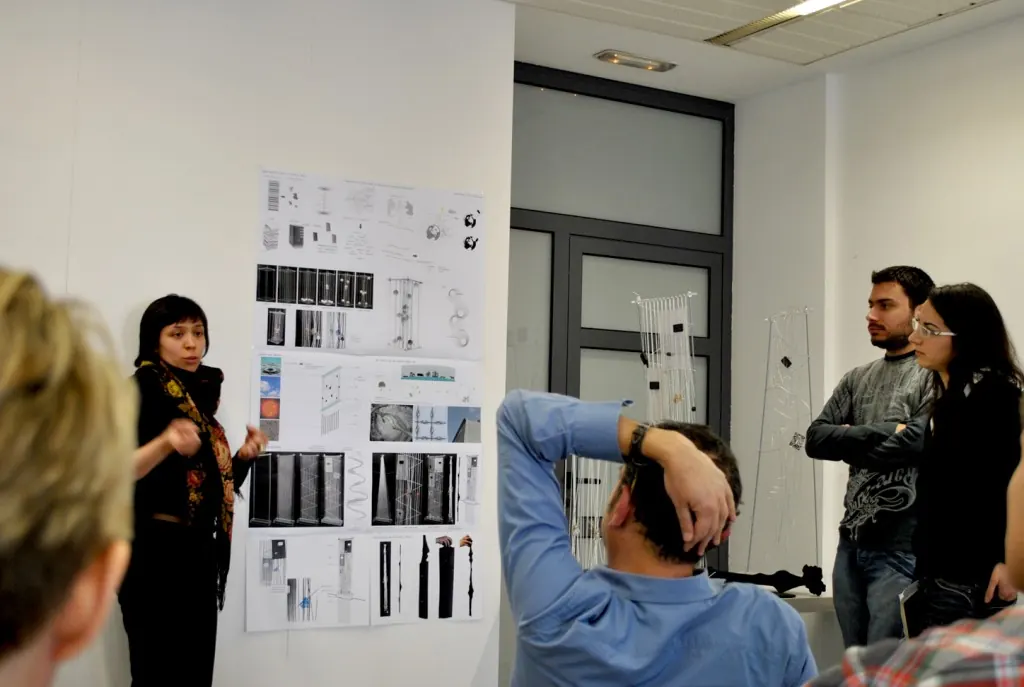
Pier Vittorio Aureli, Iñaki Ábalos and Pere Riera taught side by side. Their students worked on very different questions.