Mark Chown of Arup on sustainable building services
A guest lecture looked at pipes, power and waste, the parts of a building that its users rarely see.
Students on a course about sustainable building services heard how the subject looks from inside an engineering firm. Their guest was Mark Chown, then head of the Spanish office of Arup, a global engineering and design consultancy. One of the Arup projects shown with the notes is the Alhóndiga cultural centre in Bilbao.
Building services are the mechanical and electrical systems that keep a building working. Because they run through the same space as everything else, they have to be designed together with it.
What the course asked
Juan Gallostra, an engineer who has been general director of Grupo JG in Barcelona, led the course. It dealt with the limits and possibilities of designing services. The students studied how these systems interact with the structure, with circulation (the routes people take through a building) and with the envelope, the outer skin that separates inside from outside.
What Mark Chown talked about
The lecture took the principles from the course and set them against Arup’s practical experience, its approaches and its tools. Carbon-neutral building was one topic. Self-sustaining water cycles were another, along with the use of local resources.
Chown went on to the building site. He covered logistics, the planning of how materials and people move, and the control of waste.
He showed highlights from Arup’s work. He stressed that designers have to learn to cope with future changes in the climate. At every stage of a design, he said, the work can also make a positive contribution to society and the environment.
Read next
 Energy and form
An engineer listed forms of energy from supernovae to home geothermal kits. The next speaker asked how much land the alternatives would need.
- Javier García-Germán
He founded an office, edited books on energy and said that an architect’s work has moved off the drawing board.
 A day at the Ecopark
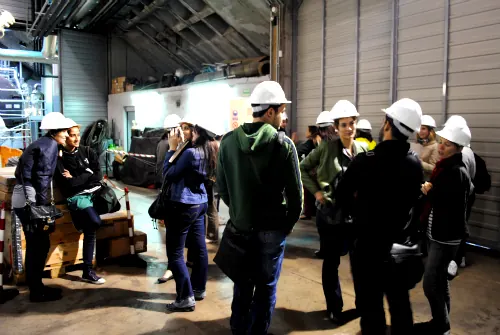
One excursion, two stops: a plant that handles rubbish and a plant that supplies buildings across a district.